By David Thompson · Published March 27, 2026 · Updated September 18, 2026 · 12 min read
The fax machine was invented in 1843 by Scottish clockmaker Alexander Bain — more than three decades before Alexander Graham Bell invented the telephone. Most people assume fax is a product of the 1980s, a relic of the pre-internet office; in reality it is one of the oldest electrical communication technologies in existence.
From Scottish clockmakers to NASA satellite technology to modern smartphone apps, fax has undergone a longer and stranger evolution than almost any other communication technology. This complete history traces every major chapter.
Quick Fact
The word "facsimile" comes from Latin: fac ("make") + simile ("similar") — literally "make a copy." The abbreviated form "fax" only became common in the 1970s.
When Was the Fax Machine Invented?
The fax machine was invented in 1843 by Scottish inventor Alexander Bain, who patented his "Electric Printing Telegraph" (British Patent No. 9745) — making fax 33 years older than the telephone (1876). The modern fax machine arrived in 1964 with the Xerox LDX, and the first commercial fax service launched back in 1865.
The Complete Fax Timeline at a Glance
| Year | Milestone | Significance |
|---|---|---|
| 1843 | Alexander Bain patents the Electric Printing Telegraph | First fax concept — uses synchronized pendulums to scan and reproduce documents |
| 1848 | Frederick Bakewell demonstrates the Image Telegraph | Replaces pendulums with rotating cylinders; first public demo at London's Great Exhibition (1851) |
| 1865 | Giovanni Caselli launches commercial pantelegraph service | First commercially operated fax service — Paris to Lyon; transmits ~5,000 faxes in first year |
| 1880 | Shelford Bidwell's scanning phototelegraph | First device to scan any two-dimensional original using selenium cells |
| 1907 | Arthur Korn transmits photograph Berlin–Munich | Bildtelegraph introduces photoelectric scanning; adopted by police and news agencies |
| 1921 | Bartlane System — first digital image transmission | Digitized newspaper photos sent London–New York via submarine cable in under 3 hours |
| 1924 | First transatlantic wireless photo transmission | RCA's Richard Ranger transmits photo of President Coolidge from New York to London |
| 1948 | Western Union Deskfax | First consumer-targeted compact fax device using spark printer paper |
| 1964 | Xerox LDX — first modern commercial fax | 900 lb machine leased at $800/month; 8 pages per minute; connected via telephone |
| 1966 | Xerox Magnafax Telecopier | 46 lb portable fax; 6 minutes per page; plugged into any standard phone line |
| 1980 | ITU Group 3 Standard (T.4/T.30) | Universal compatibility standard; any fax machine could now talk to any other — ignites the boom |
| 1985 | GammaFax — first computer fax board | PCs can now send and receive faxes directly; begins the shift to software faxing |
| 1996 | eFax launches — first online fax service | Faxes receivable via email; no machine required; cloud fax era begins |
| 1997 | US fax machine sales peak | Highest point of standalone fax hardware sales before internet email takes over |
| 2026 | Cloud fax market: $2.52 billion | Fax lives on in healthcare, legal, and government — now delivered via apps and APIs |
1843: Alexander Bain and the Birth of Fax
The history of fax machines begins not in a corporate lab, but in the workshop of a Scottish clockmaker.
Alexander Bain (1810–1877) was born in Watten, Caithness — a small village in northern Scotland. On May 27, 1843, he received British Patent No. 9745 for his "Electric Printing Telegraph," the device now recognized as the world's first fax machine concept.
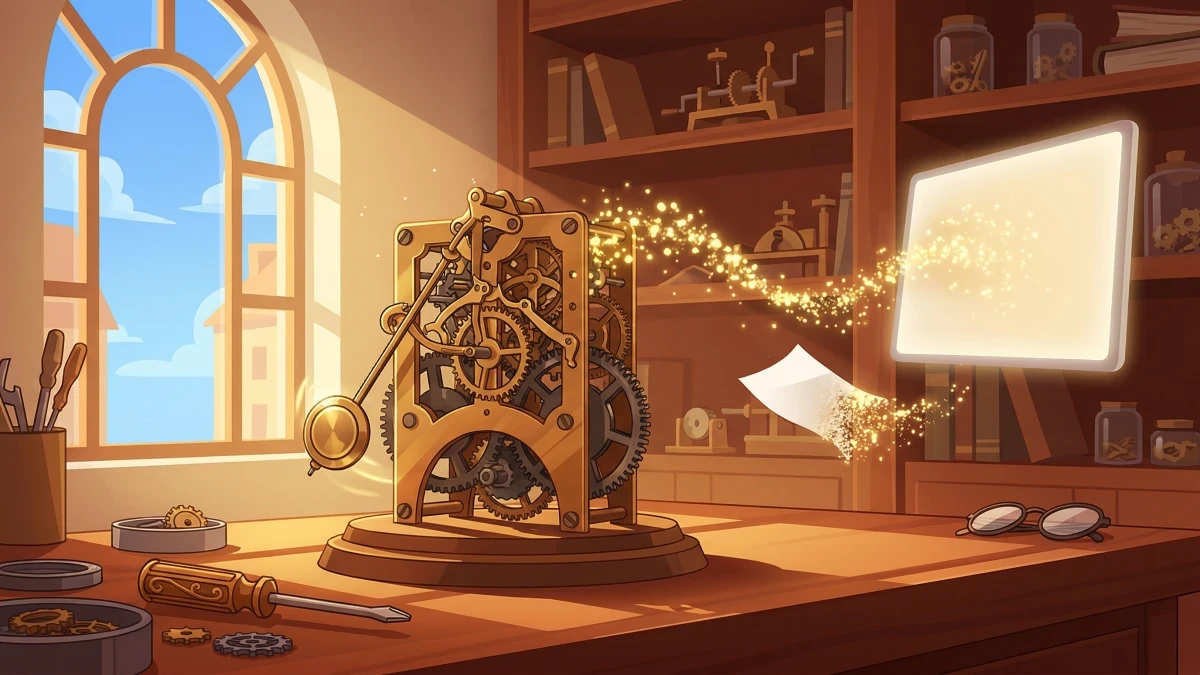
Bain's invention used two synchronized clock pendulums — one at the transmitter, one at the receiver — to scan a flat metallic surface containing the document. The transmitter stylus moved across raised metal type, completing an electrical circuit wherever the type was present. The receiver stylus marked chemically-treated paper with a current, recreating the document line by line.
The genius of the device lay in synchronization: both pendulums had to swing at exactly the same rate for the received image to match the sent one. This synchronization problem would occupy inventors for the next 60 years.
Patent Dispute
Bain's patent triggered a legal battle with telegraph pioneer Charles Wheatstone, who accused him of stealing ideas. The Royal Society investigated and sided with Bain, ruling his invention was independent and original.
Bain's device worked in principle but produced unreliable results in practice. The mechanism was too dependent on precise clock synchronization, and image fidelity was poor. It never became a commercial product — but it established the foundational concept that every fax machine since has built upon.
1848–1851: Frederick Bakewell and the Great Exhibition Demo
English physicist Frederick Bakewell refined Bain's concept by replacing the pendulums with synchronized rotating cylinders — a design that would define fax machine architecture for the next century.
Bakewell received his patent in 1848. He wrapped a transmitter cylinder in tinfoil, onto which the document was drawn in insulating ink. A stylus moved in a spiral path across the rotating cylinder, reading the electrical variations created by the contrast between the conductive foil and the insulating ink.
His moment came at The Great Exhibition of 1851 in London's Crystal Palace — the world's first international technology expo. Bakewell demonstrated live transmission of handwriting and simple drawings to an astonished public. It was the first time most people had seen any form of image transmission technology.
The system still had the synchronization problem and proved too slow and expensive for commercial deployment. But the public demonstration planted a powerful idea in the minds of inventors and investors across Europe.
1865: The World's First Commercial Fax Service
The leap from laboratory curiosity to commercial service was made by an Italian inventor with an unlikely ally: Napoleon III.
Giovanni Caselli (1815–1891) was a physicist and former priest who began developing his "pantelegraph" in the mid-1850s. Unlike his predecessors, Caselli solved the synchronization problem with a precision pendulum clock that kept both transmitter and receiver perfectly in step — regardless of the distance between them.
The pantelegraph used a stylus on a pivot arm (a pantograph) to scan a flat metal plate on which the message was written in insulating varnish. The stylus completed or broke an electrical circuit as it moved, transmitting a signal to a receiver that reproduced the marks on chemically-treated paper.
Key milestones in Caselli's story:
- 1860: Napoleon III witnessed a demonstration and ordered the pantelegraph integrated into the French national telegraph network, providing Caselli with both funding and access to existing telegraph lines.
- November 1860: A successful long-distance test transmitted the signature of composer Gioacchino Rossini over 140 km between Paris and Amiens.
- 1861–1865: Tsar Alexander II ran an experimental service between his palaces in St. Petersburg and Moscow.
- February 1863: The first public commercial service launched between Paris and Lyon.
- 1865: Full-scale commercial operations began. In its first year, the service transmitted nearly 5,000 faxes — with peak throughput of 110 faxes per hour.
- 1867: The service extended to Marseille.
Caselli was awarded the Legion of Honor by Napoleon III. The Paris-Lyon pantelegraph service represents the world's first commercially operated facsimile service — operating 11 years before the telephone was invented.
The service ultimately shut down around 1870 due to the disruption of the Franco-Prussian War, but it had proven the concept: fax was not just a novelty. It was a viable communication service.
1900s: Arthur Korn and the Photo Transmission Breakthrough
For the next few decades after Caselli, fax technology advanced incrementally. The breakthrough that opened the modern era came from a German physicist who figured out how to transmit photographs.
Arthur Korn (1870–1945) invented the Bildtelegraph ("picture telegraph") around 1900, using photoelectric cells to convert the varying light intensities of a photograph into electrical signals.
Where earlier fax systems could only transmit black-and-white line art (handwriting, signatures, simple drawings), Korn's photoelectric approach could capture and reproduce continuous-tone grayscale images — photographs.
The milestones:
- 1907: Korn transmitted a photograph from Munich to Berlin — the first successful photo-facsimile transmission in Germany.
- 1908: A photograph of a wanted criminal was transmitted from Paris to London, demonstrating an immediate law enforcement application. This generated enormous press coverage across Europe.
- 1923: Korn transmitted a photo of Pope Pius XI from Rome to Bar Harbor, Maine — one of the earliest transatlantic photo transmissions.
Korn's technology was quickly adopted by news wire services and police departments across Europe. Newspapers that received timely photos from distant locations gained a massive competitive advantage — wire photo services became a cornerstone of 20th-century journalism.
1921–1926: The Digital Pioneer — The Bartlane System
Before anyone had heard the word "digital," a system using digital principles changed transatlantic communications.
In 1921, Harry G. Bartholomew and Maynard D. McFarlane invented the Bartlane system for transmitting newspaper photographs between London and New York via submarine cable.
The system worked by encoding a photograph's tonal values as a series of punched holes in telegraph paper — a form of digital encoding. The receiver reconstructed the image from those encoded values.
The result: transatlantic picture delivery time dropped from more than a week (by ship) to under three hours. By 1926, the Bartlane system was in regular commercial use. It is now considered the world's first digital imaging system.
The broader wire photo industry expanded rapidly:
- AT&T launched its Wirephoto service in 1924
- RCA began Radiophotos in 1926
- On November 29, 1924, RCA's Richard Ranger transmitted a photograph of President Calvin Coolidge wirelessly from New York to London — the first transatlantic radio facsimile
1964–1966: Xerox and the Modern Fax Machine
The story jumps forward to 1964, when Xerox Corporation — already dominant in photocopying — made the first real attempt to commercialize a modern office fax machine.
The Xerox LDX (1964)
The LDX (Long Distance Xerography) was Xerox's first commercially sold fax machine. The specs reflect how far the technology had come — and how far it still had to go:
- Weight: ~1,100 lbs (499 kg)
- Monthly lease cost: $800 (~$8,000 in today's dollars)
- Speed: 8 pages per minute
- Transmission medium: Dedicated telephone lines
Despite its cost and bulk, the LDX found customers among corporations and government agencies that needed reliable, fast document transmission between offices.
The Xerox Magnafax Telecopier (1966)
Two years later, Xerox released the Magnafax Telecopier — a dramatically more practical machine:
- Weight: 46 lbs (21 kg) — portable enough to carry
- Connectivity: Any standard telephone line
- Speed: ~6 minutes per page
The Magnafax was the product that first made office fax accessible. It required no dedicated infrastructure — if you had a phone line, you could send a fax. Sales were modest but growing, and the product established fax as a legitimate office tool.
By the late 1960s, several manufacturers had entered the market, and Dacom developed the first digital fax machine (the Rapidfax), incorporating compression technology originally developed for satellite communications — cutting transmission time from 6 minutes to 1 minute per page.
1966–1980: The Standards Problem
For fax to become truly universal, there was one critical problem to solve: incompatibility.
In the late 1960s and 1970s, a fax machine from one manufacturer couldn't communicate with a machine from a different manufacturer. Every company had its own proprietary protocol. This meant businesses had to match hardware with their communication partners — a severe constraint on adoption.
The CCITT (International Telegraph and Telephone Consultative Committee, now part of the ITU) set out to solve this with a series of international standards called "Groups":
| Standard | Year | Speed | Key Advance |
|---|---|---|---|
| Group 1 | 1966 | ~6 minutes/page | Analog; first international standard |
| Group 2 | 1976 (T.3) | ~3 minutes/page | First true interoperability standard |
| Group 3 | 1980 (T.4/T.30) | 40 sec – 6 min/page | Digital; 9,600 bps; universal adoption |
| Group 4 | 1984 | Seconds/page | Digital ISDN; 64 kbit/s |
The Group 3 standard in 1980 was the turning point. Developed primarily by Japan's NTT and KDDI, Group 3 created a universal digital protocol for fax over standard telephone lines. Any Group 3 machine could now communicate with any other Group 3 machine, regardless of manufacturer.
This was the spark that ignited the 1980s fax explosion.
1980s: The Fax Boom
The 1980s fax boom is one of the fastest technology adoption stories in communication history.
Once Group 3 standardization took hold, Japanese manufacturers — Canon, Panasonic, Sharp, Ricoh — competed ferociously to produce faster, smaller, cheaper machines. Prices plummeted. By the mid-1980s, a fax machine that had cost thousands of dollars in 1975 could be purchased for a few hundred.
Why Japan Led the World in Fax Adoption
Fax was uniquely well-suited to Japan's writing system. Japanese uses three scripts — kanji, hiragana, and katakana — making keyboard text entry cumbersome for everyday business communication. Writing and faxing was far easier. This gave Japan a cultural incentive for fax adoption that didn't exist in alphabetic-language countries, and Japanese manufacturers responded by building the hardware that eventually reached every office worldwide.
Key 1980s milestones:
- 1983: The Group 3 9,600 bps protocol was widely adopted across manufacturers, cementing compatibility
- 1985: Hank Magnuski at GammaLink produced the GammaFax — the first computer fax board, allowing PCs to send and receive faxes directly
- By 1987: Millions of fax machines were in operation globally; "Please fax it to me" entered everyday business language
- By the early 1990s: Virtually every business office worldwide had at least one fax machine
At its peak, the US alone saw an estimated 200 billion fax pages transmitted per year, averaging roughly 6,000 pages per second.
How a Fax Machine Actually Works
Understanding how a fax machine works helps explain why it became so dominant and why it survives today.
A standard Group 3 fax transmission follows these steps:
- Scanning: The document feeds through the machine past a row of 1,728 CCD (Charge-Coupled Device) photosensors that measure each point as black or white.
- Digitization: The photosensor readings are converted to a binary bitstream — 0 for white, 1 for black.
- Compression: The bitstream is compressed using run-length encoding, which efficiently encodes long stretches of white space. A page of text is mostly white — this can reduce file size by 90%.
- Modulation: Compressed digital data is converted to audio tones by a built-in modem so it can travel over standard analog telephone lines.
- Transmission: Audio tones travel over the PSTN (Public Switched Telephone Network) to the receiving machine.
- Reconstruction: The receiver's modem converts tones back to digital data, decompresses it, and rebuilds the bitmap image.
- Printing: The image is printed — originally on thermal paper, later on plain paper via laser or inkjet.
The elegance of this system: it required no special infrastructure beyond a telephone line, and no software compatibility between sender and receiver — just the shared Group 3 protocol. This universality is exactly why fax became the global document standard before email had a chance to compete.
The 1990s: Fax Meets the Internet
The internet didn't kill fax immediately — but it introduced a powerful competitor.
1992: The establishment of MIME (Multipurpose Internet Mail Extensions) allowed email to carry file attachments, directly competing with fax's core function of transmitting documents. As PC penetration grew — from 130 million units globally in 1991 to 775 million by 2004 — email accounts multiplied faster than anyone had anticipated.
1993: The PDF format was standardized, giving email a way to transmit documents with fidelity matching a fax. The argument for fax weakened.
1996: eFax launched as the first major online fax service. For the first time, you could receive a fax as an email attachment — no machine, no dedicated phone line, no thermal paper. The cloud fax era had begun.
1997: US standalone fax machine sales peaked, then began their long decline.
2000: Japan's fax machine sales peaked — somewhat later than the US, reflecting the deeper cultural entrenchment of fax in Japanese society.
But fax didn't simply surrender to email. It pivoted to the sectors where its unique properties mattered most.
Fax in the 21st Century: Healthcare, Law, and Government
The persistent use of fax in the 2020s is not nostalgia or inertia — it reflects specific, rational reasons why fax is still the right tool for certain jobs.
Healthcare: Fax's Largest Remaining Market
The US healthcare industry alone exchanges over 9 billion fax pages annually. More than 70% of US hospitals and clinics still rely on faxing for inter-organizational patient record sharing.
Why healthcare fax won't go away:
- HIPAA compliance: Fax is accepted as a HIPAA-compliant method for transmitting Protected Health Information (PHI). A point-to-point telephone connection is not subject to the server-breach risks of email or cloud storage.
- Universal compatibility: Every hospital, clinic, and specialist has a fax number. Email interoperability between EHR systems is still inconsistent.
- Legal record: Fax transmissions create a documented confirmation receipt that satisfies legal and compliance requirements.
Even during the COVID-19 pandemic, Japan's Ministry of Health received all case reports by fax — healthcare workers handwriting patient data on forms and faxing them to regional offices.
Legal and Government
Courts, government agencies, and financial institutions accept faxed documents as legally binding with timestamps that serve as evidence of delivery. The UK's NHS was the world's largest single purchaser of fax machines as recently as 2018, operating approximately 11,620 machines.
In Japan:
- A 2020 Ministry of Internal Affairs study found 33.6% of Japanese households still own fax machines
- Over 90% of Japanese local governments still used fax for daily communication as of 2022
- Elementary schools still send and receive absence notifications by fax
In 2021, Japan's government launched a high-profile initiative to abolish fax use in government agencies — and encountered significant institutional resistance.
The Modern Fax Market
Fax Market 2026
The global fax services market is valued at $3.31 billion in 2024, projected to reach $4.47 billion by 2030. The cloud fax segment is growing faster — $2.52 billion in 2024, heading toward $4.54 billion by 2033. Physical fax hardware is in decline, but the fax protocol is as active as ever.
Today, fax is increasingly software-defined. Services like mFax.to let anyone send a fax from a smartphone in under two minutes — no machine, no phone line, no thermal paper. The protocol is the same Group 3 standard from 1980; only the hardware has been abstracted away.
For businesses with HIPAA, legal, or regulatory requirements, mFax Business provides virtual fax numbers, team accounts, and audit trails from about $9/mo (billed annually) — and rather than rigid fixed tiers, you build your own plan by choosing exactly the seats and page volume you need, so you get all the compliance of a traditional fax line without a single machine on the premises.
What the History of Fax Teaches Us
The fax machine's 180-year history offers a few durable lessons about technology adoption:
Universality beats superiority. Email is objectively better than fax in most ways — cheaper, faster, searchable, easy to forward. Yet fax persists because it has universal point-to-point compatibility that no competing standard has matched in regulated industries. The Group 3 standard of 1980 still operates reliably between any two fax endpoints anywhere in the world.
Standards are the real invention. Bain, Bakewell, and Caselli built remarkable machines that went nowhere commercially because each was proprietary. The CCITT Group 3 standard did more to create the fax industry than any single piece of hardware.
Technology doesn't die — it finds its niche. Fax is no longer a general business communication tool, but in healthcare, law, and government, it is entrenched in ways that may take decades to change. The same pattern plays out with every technology that gets displaced from general use but retains a defensible position in specific domains.
The fax machine survived the telephone, two world wars, the PC revolution, and the internet. It will likely outlast many of the technologies we currently assume will replace it.
Ready to send a fax without the machine? mFax.to lets you fax from your phone in under 2 minutes — no hardware, no phone line, no waiting. Over 5 million users have already made the switch.